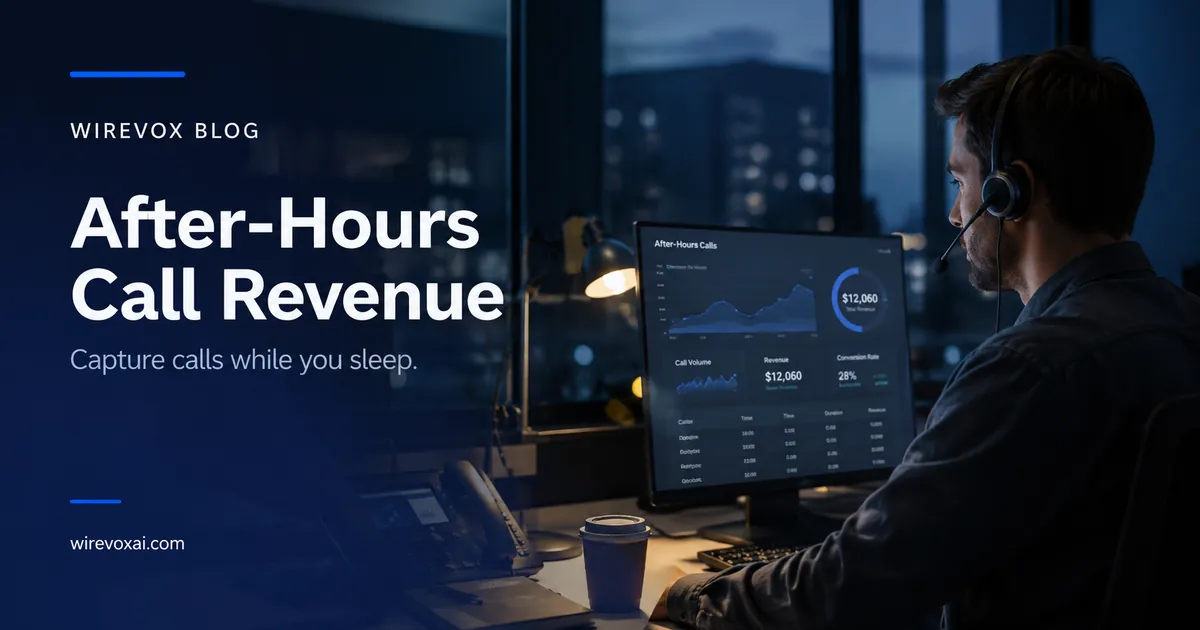
Your marketing does not clock out at 5 PM.
People search for dentists when a tooth starts throbbing at 9 PM. Homeowners call plumbers on Saturday morning. Buyers tour homes after work and dial listing numbers on the drive home.
If those calls hit voicemail, you did not just “miss a call.” You paid for the click—and handed the customer to whoever answered first.
Why After-Hours Is Where Intent Peaks
After-hours callers are often:
- In pain or urgency (healthcare, home services, legal emergencies)
- Done with their day job and finally free to book
- Comparing 2–3 businesses in one sitting on Google
Speed wins. The first professional voice that can answer questions and book usually gets the appointment. That is the same speed-to-lead problem we outline in The Death of the Missed Call.
What “Good” After-Hours Coverage Looks Like
Answering services of the past often failed because they:
- Used rigid scripts with no calendar access
- Could not quote realistic availability
- Sounded disconnected from your brand
- Created a next-day callback pile for your staff
A modern AI voice agent is different when it can:
- Answer on the first ring, 24/7
- Pull live availability from your calendar
- Book, reschedule, or take a structured message
- Escalate true emergencies with clear rules
- Sync notes into your CRM via integrations
Industry Snapshots: Where Night Calls Convert
Healthcare & clinics
Healthcare calls can involve sensitive information. Limit automation to an approved administrative workflow, define staff escalation, and confirm privacy and contractual requirements before launch. Explore healthcare solutions.
Dentistry
Emergency toothache traffic is after-hours gold. See how practices automate intake in our dentistry deep dive and dentistry solutions.
Real estate & home services
Evening inquiries are decision-time inquiries. Pair after-hours agents with the patterns in voice AI for real estate & home services.
Spa & wellness
Same-day and next-morning bookings often happen at night while clients browse phones on the couch—ideal for a polished AI receptionist.
The Math (Simple Version)
Assume:
- 20 after-hours calls per week
- 30% would have booked if answered live
- Average job / appointment value: $200
That is roughly 6 bookings × $200 × 52 weeks ≈ $62,400/year of recoverable opportunity—before counting reputation and review lift from actually answering.
Compare that to a night shift salary, or to AI receptionist cost that scales with minutes, not headcount.
How to Turn On After-Hours Without Chaos
- Define business hours in your agent (day staff vs AI coverage).
- Load FAQs and policies into a knowledge base—hours, insurance, service areas, cancellation rules.
- Connect calendar so the agent only offers real slots.
- Write escalation rules (emergency → on-call human; sales → book consult).
- Review transcripts in call analytics every morning for a week.
For a full setup walkthrough, use How to Set Up an AI Phone Agent in Under an Hour.
Scripts That Convert at Night
Night callers are tired and impatient. Keep the first 10 seconds:
- Brand name
- Empathy (“Sorry you’re dealing with this after hours…”)
- Clear help (“I can book the next available appointment or take details for the team.”)
Avoid robotic menus. Natural turn-taking (and low latency) matters more after hours when patience is thin—see why latency matters and how to write non-robotic agent scripts.
Bottom Line
After-hours is not a “nice to have.” It is often your highest-intent, lowest-competition window—if someone answers.
Wirevox is built for exactly that: 24/7 AI voice agents that book, qualify, and log every call. Check pricing, try the AI receptionist path, or book a demo to map your night call volume to revenue.
See how Wirevox can work for your business —
Book a free demo