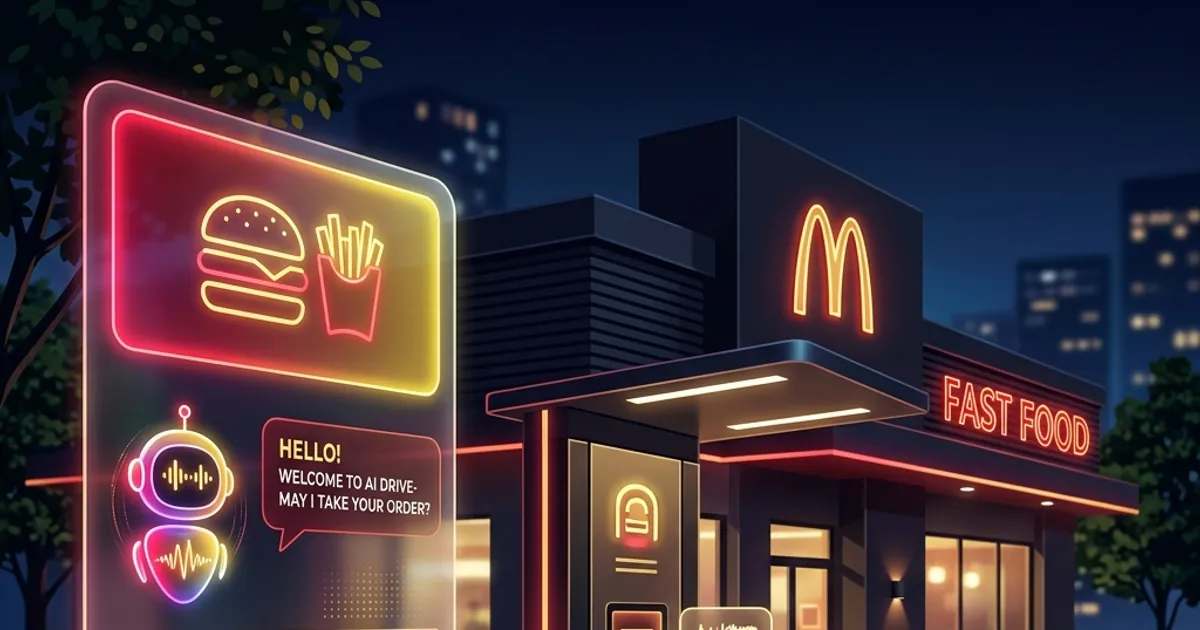
The fast-food industry is undergoing a seismic technological shift, and the Golden Arches are once again at the forefront. After a highly publicized, and somewhat rocky, automated order-taking experiment with IBM, McDonald’s has announced a renewed push into AI voice ordering at the drive-thru. This time, they are bringing in a new heavyweight partner: Google Cloud.
This latest announcement isn't just about getting your Big Mac order right; it’s a calculated move to dramatically restructure restaurant economics. By implementing advanced AI, industry analysts project that McDonald's could eventually slash its drive-thru specific labor costs from hundreds of millions of dollars down to a fraction of that amount.
Here is a detailed breakdown of McDonald’s latest AI announcement, the rocky road that led here, and the staggering financial math behind the automation of the drive-thru.
Enter "Archy": The Google Cloud Partnership
In mid-2026, McDonald’s confirmed a new pilot program testing an AI-powered voice ordering system at a select group of U.S. locations. Unlike its previous iteration, this new system—affectionately dubbed "Archy" (and sometimes referred to internally as ArchIQ)—is built on Google Cloud's robust AI infrastructure.
According to reports from Restaurant Business Online and tech analysts, this partnership leverages Google’s advanced natural language processing to create a more reliable "operating layer."
Key features of the new Google-powered system include:
- Higher Accuracy: Early tests indicate that "Archy" can handle over 1 million transactions with human intervention required only about 10% of the time, a massive leap from previous iterations.
- Real-Time Ping System: If the AI encounters a complex order, a heavy accent it cannot parse, or a multi-car situation, it immediately pings a human manager in real-time to take over, ensuring the customer experience remains seamless.
- Direct-to-Kitchen Integration: The AI bypasses the traditional Point of Sale (POS) entry, sending orders directly to the kitchen display screens to shave crucial seconds off drive-thru times.
The Financial Catalyst: From Hundreds of Millions to Under $40 Million
Why is McDonald's so relentless in its pursuit of the AI drive-thru? The answer lies in the balance sheet.
Fast-food chains have been battling rising labor costs for years. With minimum wages increasing across key markets like California (which recently bumped fast-food worker minimums to $20/hour) and inflation squeezing margins, optimizing labor is a top priority.
Historically, manning the drive-thru speaker requires dedicated staff. Across McDonald's thousands of locations, the cumulative wage bill for drive-thru order takers alone runs into the hundreds of millions of dollars annually.
However, with the implementation of a highly accurate AI system like Archy, the economic model flips. Analysts tracking the sector note that if human intervention drops to just 10% (the current success rate of the Google pilot), restaurants will only need a fraction of the staff monitoring the headsets.
Instead of paying hundreds of millions for dedicated order-takers across the franchise network, theoretical models suggest the wage allocation specifically for taking drive-thru orders could plummet to under $40 million system-wide (accounting primarily for the "human-in-the-loop" exception handlers). The savings generated wouldn't just pad the bottom line; executives argue it allows restaurants to reallocate labor to food preparation, table service, and overall hospitality, effectively doing more with fewer total labor hours.
(For deeper economic analysis on fast-food labor models, see reports from 24/7 Wall St. and the Institute of Labor Economics).
Learning from the Past: The IBM Era
To understand the significance of the Google partnership, one must look at McDonald's recent past. In 2021, McDonald's partnered with IBM to develop an Automated Order Taker (AOT). The system was rolled out to over 100 locations.
However, by mid-2024, McDonald's abruptly ended the IBM partnership. The system struggled with background noise, diverse accents, and complex menu modifications. It famously went viral on platforms like TikTok and Reddit when the AI added hundreds of dollars worth of unwanted chicken nuggets to orders, or accidentally merged orders with cars in the adjacent lane (as reported by Global News).
McDonald's learned a valuable lesson: an AI drive-thru cannot just be "good enough"—it must be nearly flawless to prevent drive-thru bottlenecks. The pivot to Google Cloud represents a focus on deeper contextual understanding and better fail-safes (like the real-time manager ping) rather than just basic voice transcription.
An Industry-Wide Arms Race
McDonald's isn't the only giant chasing this multi-million dollar wage savings. The entire Quick Service Restaurant (QSR) industry is engaged in an AI arms race:
- Wendy's: Partnered with Google Cloud earlier to test "Wendy's FreshAI," which has shown promising results in Ohio test markets.
- Taco Bell & Yum! Brands: Actively rolling out voice AI to hundreds of drive-thrus, focusing on upselling accuracy (e.g., "Would you like to add a freeze to that?").
- White Castle: One of the earliest adopters, utilizing SoundHound's AI technology to automate its lanes.
(Read more about the QSR AI race on Newsweek and The Guardian).
The Democratization of Voice AI: Enter Wirevox
While mega-corporations like McDonald's, Wendy's, and Taco Bell are spending billions developing proprietary AI systems with tech giants like Google and IBM, the underlying technology is rapidly becoming accessible to the rest of the business world.
This is exactly what platforms like Wirevox are building towards. Wirevox provides an enterprise-grade, ultra-low-latency voice AI platform designed specifically for agencies and resellers. Instead of requiring a massive internal engineering team, Wirevox allows marketing agencies and SaaS businesses to deploy the exact same caliber of conversational AI for their own clients' inbound reception and outbound sales needs.
By offering a robust white-label infrastructure, seamless real-world tool execution (like natively booking a calendar appointment mid-conversation), and dynamic Knowledge Base (RAG) integration, Wirevox is effectively taking the cutting-edge voice AI technology McDonald's is pioneering and democratizing it for the broader B2B ecosystem.
Conclusion: The Future of Voice AI
The McDonald's-Google Cloud announcement signals that AI in voice ordering is no longer a gimmick; it is an economic necessity. By shifting the bulk of order-taking to an AI agent like "Archy," McDonald's is positioned to drastically reduce one of its largest line-item expenses.
Meanwhile, platforms like Wirevox are ensuring that these massive leaps in efficiency aren't just reserved for Fortune 500 companies. While there will inevitably be growing pains across the industry, the days of speaking to a human through a static-filled speaker box are numbered. The future of communication is automated, highly optimized, and powered by the cloud.
Tags: #McDonalds #ArtificialIntelligence #GoogleCloud #Wirevox #DriveThruAI #RestaurantTech #LaborEconomics #FastFood
See how Wirevox can work for your business —
Book a free demo